

A system for inducing defined impact damage in test specimens for the purpose of developing non-destructive testing methods.
New materials such as hybrid materials GLARE (Glass Fibre Reinforced Aluminium or Glass Laminate Aluminium Reinforced Epoxy) or "carbon-fibre-reinforced plastics" (CFRP) and "glass-fibre-reinforced plastics" (GFRP) have been displacing traditional materials such as aluminium for some time or replacing them on exposed elements due to their properties. The advantage in comparison to aluminium - until now the standard material in aircraft construction - lies in its better burn-through and impact behaviour. Another advantage over aluminium is its behaviour towards cracks. Cracks are "bridged" by the glass fibre layers, so that the crack speed decreases with increasing crack length, whereas with aluminium the crack speed increases strongly. Therefore, it is used primarily because of its behaviour towards cracks in the upper fuselage area and on the underside of the wing, as well as in the nose area of the vertical stabiliser and in the cockpit area due to its impact behaviour.
Other fields of application for hybrid materials are body construction for railways (locomotive construction) and the automotive industry.
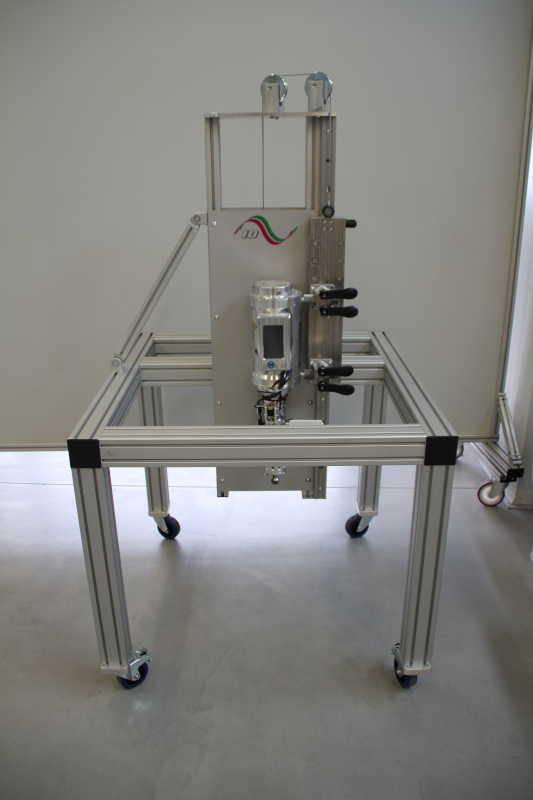
In order to be able to specifically introduce damage into the structure and assess the type of damage (mainly in the form of delamination), ID Lindner developed a mobile or portable device (mobile impactor or "mobile gas gun") in collaboration with Airbus, with which specimens and entire components can be specifically tested with predefinable energies and impact heads. This allows damage caused by low-velocity impacts such as hail or falling tools ("tool-drop") to be reproduced.
Features:
· Designed for material testing in the aviation and railway sectors
· Designed for one-person operation
· catching hooks prevent a second impact
· Material testing by generating an impact with a defined energy level using compressed air
· Available with different projectiles (different weights, different projectile heads: ball segments with different diameters)
· Effective energy adjustable from 3J (with special projectile) to 140 joules (up to 300J on request) by connecting to the in-house compressed air supply. Some energy levels cannot be combined with each other! Please contact us for special cases.
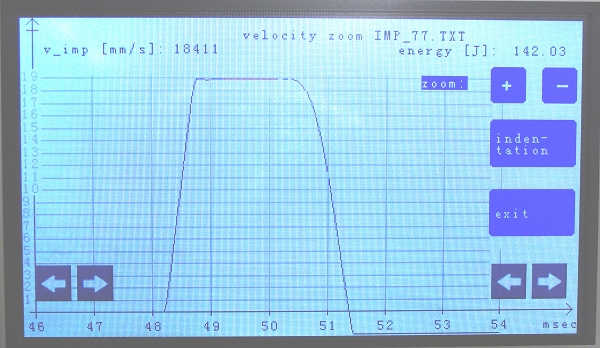
· Evaluation and display of projectile speed and energy directly on the built-in touchscreen (4.3", 480x272 pixels)
· Measurement data storage on SD card
· Data recording with 50 kHz sampling rate for penetration depth, speed, acceleration (of the device to detect recoil at high energies and thus falsification of the measurement result)
· A mobile compressor is available on request if no compressed air supply is available.
· Dimensions Impactor: 270 x 600 x 200mm (w x h x l)
· Weight: 10 kg (250J: 11.3kg)
· Impact energy: Standard: max. 140 J at approx. 6 bar
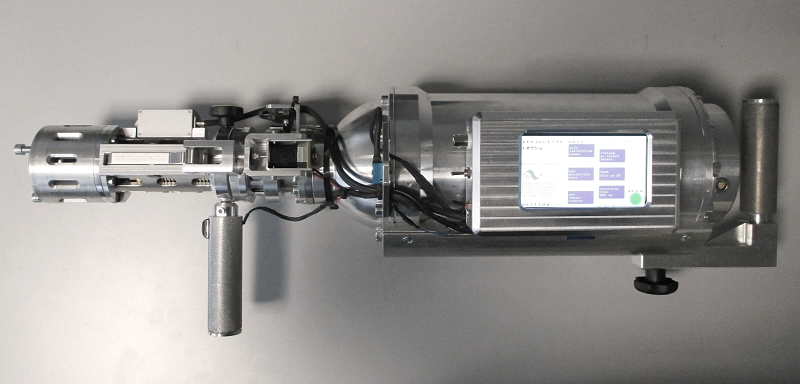
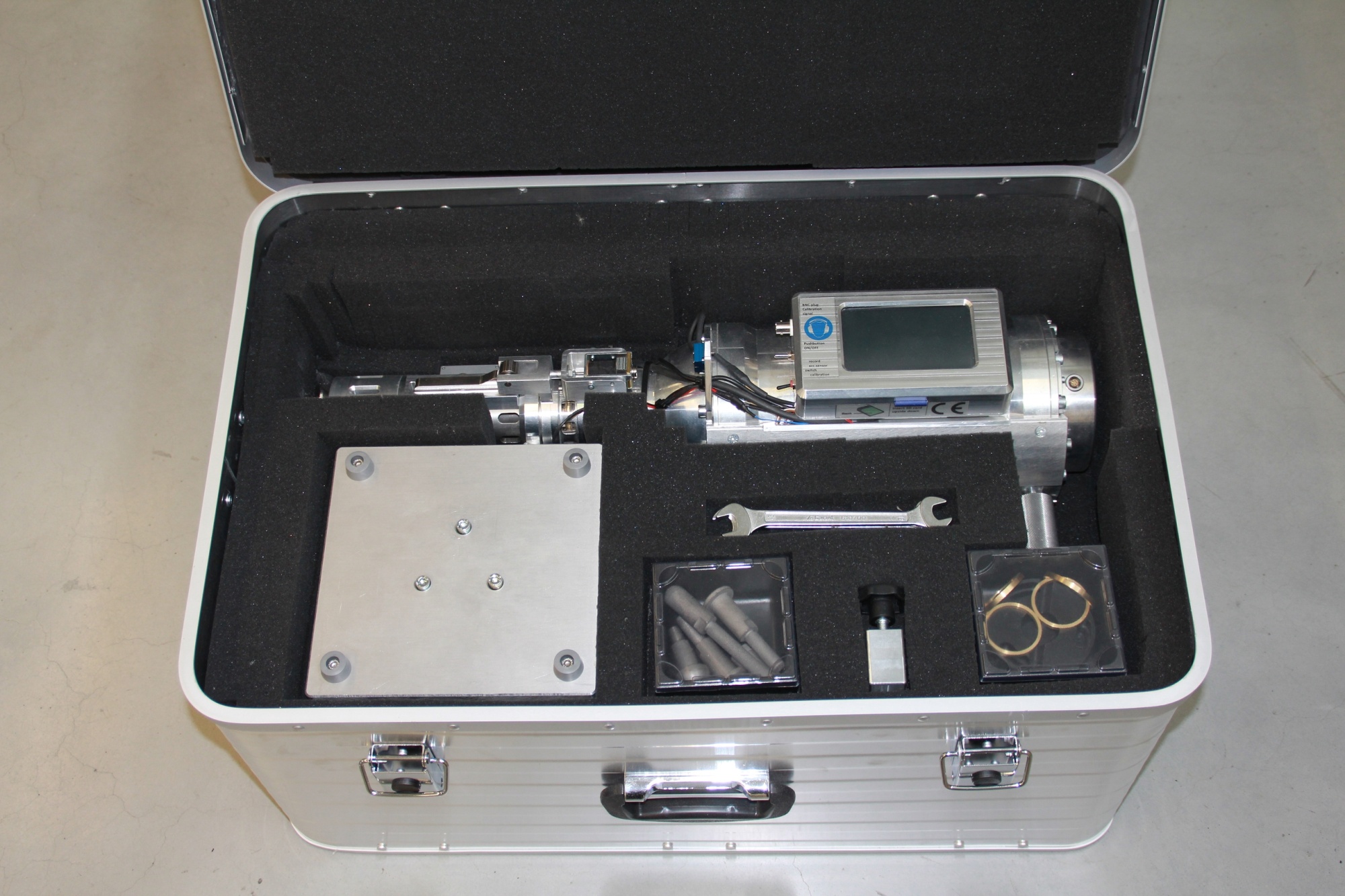
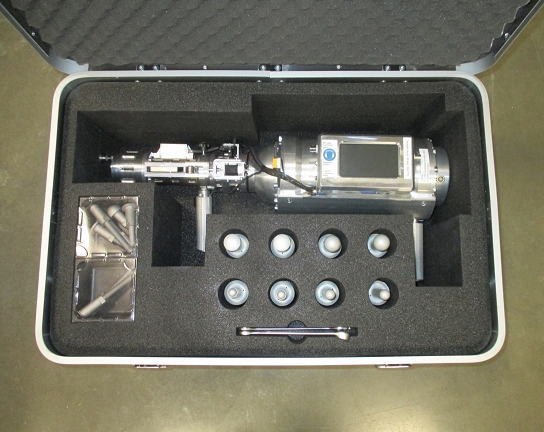
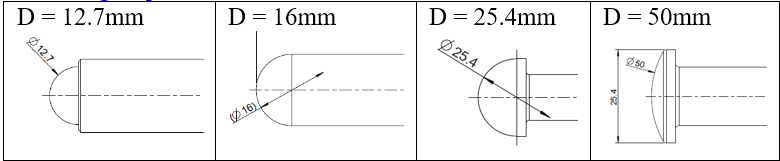
onsite evaluation of Impacts:
Graphical determination of the velocity at the moment of impact, calculation of the energy of the projectile
Impact test rig in aviation industry
In order to introduce new materials into the aircraft industry, such as fiber-reinforced plastics/aluminum, it is necessary to know how they behave in the event of unforeseen impacts. For this purpose, an existing impact test rig belonging to a European aircraft manufacturer was upgraded so that a force sensor can be used to scan, measure, and document the force curve occurring during impact and the displacement and velocity curves at a high frequency of 50 kHz without contact.
The impact dome, drop weight, and drop height can be freely selected within certain limits. Another drop test rig was retrofitted with a falling acceleration sensor and contactless displacement and velocity measurement. All measurement data is also sampled at 50 kHz. Automated operation was implemented for both drop test rigs. Control is performed using appropriate measurement software, which can be used to record, visualize, and store the data.
The measurements are taken using a USB measurement box. Impact energy, energy dissipation, velocity profile, and penetration depth during the impact and rebound can thus be evaluated.


